Thursday, February 25, 2010

MSI shows its HD 5870 Lightning

Image

Officially this time

Although its been already detailed and pixellized a while back, MSI has finally announced its HD 5870 Lightning card. This special, Lightning series, HD 5870 features a custom PCB, Twin Frozr II cooler and a 15-phase VRM, so this one is built for high and most likely impressive overclocking results.

The card features a 900MHz factory overclock for the GPU and 1GB of GDDR5 memory clocked at 4800MHz. Due to the 15-phase VRM (13-phase GPU + 2-phase memory), the card needs two 8-pin PCIe power connectors. As you can see from the pictures below, the card features a quite unique PCB which is a bit higher than the normal one. MSI calls this PCB a LPL, or Lightning Power Layer, and the card features Hi-c CAPs, 100% Solid State Chokes, Proadlizer capacitor, gold plated connectors and V-Check points, something that we're used to seeing on MSI's overclocking friendly hardware.

The Twin Frozr II cooler has two 80mm fans and four 8mm SuperPipes heatpipes, while the card has all the regular outputs: dual DVI, HDMI and DisplayPort.

The card will most probably take a front stand at MSI's Cebit booth and will be available sometime in March. Unfortunately, the price tag has been left out.

Image

Fun Facts: How Small is 32 Nanometers?

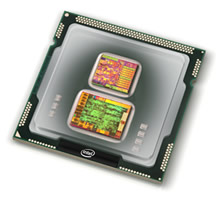
Earlier this year Intel made a big splash with a new generation of Core i3 and Core i5 processors using the uber small 32 nanometer manufacturing process. Although this is eventually going to get dumped as ancient technology for an even smaller and more efficient way to produce chips, today it's state of the art.
Intel recently published a whitepaper with some amusing 32nm facts that we are reproducing here for you. If you have ever wondered how small the logic inside these chips really is in 'measurable' terms, here are some random facts to give you some perspective:

  • A nanometer is so small that it takes a billion of them to make a meter. A billion is a huge number. A stack of a billion sheets of paper would be 100 km high. If you could walk a billion steps, you would go around the earth 20 times.
  • The original transistor built by Bell Labs in 1947 was large enough that it was pieced together by hand. By contrast, more than 60 million 32nm transistors could fit onto the head of a pin.
  • More than 4 million 32nm transistors could fit in the period at the end of this sentence.
  • A 32nm transistor contains gates that are so small, you could fit 3,000 of them across the width of a human hair.
  • A 32nm transistor can switch on and off over 300 billion times in one second. It would take you 4000 years to flick a light switch on and off that many times.
  • Compared to Intel’s first microprocessor, the 4004, introduced in 1971, a 32nm CPU runs over 4000 times as fast and each transistor uses about 4000 times less energy. The price per transistor has dropped by a factor of about 100,000.
  • The “World’s Fastest Man,” Usain Bolt would have to take 3,125,000,000 steps in the 100 meter dash if his stride length was 32nm.
  • If the pace of innovation in space travel had increased at the pace of Moore’s Law since 1971, you would now be able to travel at the speed of light, 671 million miles per hour.
  • Intel has shipped over 200 million CPUs using high-k/metal-gate transistors – the kind used in 32nm processors -- since the technology was first put into production in November 2007. This translates to over 50,000,000,000,000,000 (50 quadrillion) transistors, or the equivalent of over 7 million transistors for every man, woman and child on earth.
  • The price per transistor on a chip has dropped dramatically since Intel was founded in 1968. Some people estimate that the price of a transistor is now about the same as that of one printed newspaper character.

Core i7 980 Extreme Edition crops up

Image

€1.099,-


We’ve
written about this CPU on plenty of occasions, but our colleagues from TechReport have come across an EU listing of Intel’s new addition to its i7 series – the Core i7 980 Extreme Edition.

We’ll recap real quick – this is the first six core CPU for desktops and are based on 32nm Westmere architecture. It comes with HyperThreading, 12MB of L3 cache and supports turbo boost up to 3.6GHz. It features DDR3 support up to 1066MHz and its TDP will be at 130W.

The listing puts the CPU’s price at € 1.099,-, which is pretty good as the same retailer sells i7-975 Extreme Edition at only a tad lower price. The e-tailer lists availability date as March 14th.

You can find the CPU listed here. (in German)


Written by Nedim Hadzic, Fudzilla

ATI Radeon HD 5830 Review

AMD has been spitting out new graphics cards like crazy since launching the Radeon HD 5000 series five months ago. With today's release that translates into almost two new graphics cards each month.

Looking at the budget and mid-range segments you'll notice that there is no more than $40 separating each card. So why the big gap between the Radeon HD 5770 and 5850? As it turns out AMD has been planning to plug this hole all along with yet another offering. The Radeon HD 5830 is expected to come in at somewhere around $250, ~15% cheaper than the 5850.


Appearance and form factors aside, what we are most excited about is having a new Radeon HD 5800 product at more affordable price tag, that is, as long as AMD has kept the value proposition and performance balance as good as it sounds on paper. Let's find out.

Read the complete review.

By Julio Franco, TechSpot.com 

Saturday, February 6, 2010

New Westmere Details Emerge: Power Efficiency and 4/6 Core Plans

Today Intel started talking about its ISSCC plans and included in the conference call were some details on Westmere that I previously didn't know. Most of it has to do with power savings, but also some talk about 32nm quad-core Westmere derivatives!

Wednesday, December 30, 2009

USB 3.0: What You Need To Know

 
The Universal Serial Bus standard has come a long way since its introduction in 1996. Backed by a consortium of companies led by Intel, Compaq and Microsoft, it offered some unheard-of features for its time, including the ability to connect peripherals without turning off the computer first and to draw power without a separate AC connection. The standard became popular with the arrival of version 1.1 in late 1998, allowing a maximum transfer rate of 12Mb/s, and as we can witness nowadays just about any device comes standard with 'Hi-Speed' USB 2.0 connectivity.

Wednesday, December 16, 2009

Intel's 6-core Gulftown to debut as Core i7 980X

PC online has leaked an Intel published slide showing what appears to be the official branding for its upcoming six-core Gulftown processor. Long rumored to be released with the Core i9 identifier, the 32nm Westmere based chip will reportedly debut as the Core i7 980X instead, featuring 3.3GHz clock speeds and a whopping 12MB of L3 cache.

Individual cores will be able to hit up to 3.6GHz thanks to Turbo Boost, while Hyper-Threading support will allow it to juggle 12 threads in total. TDP remains constant at 130W helped by the newer fabrication process. The LGA 1366 chip will be able to drop straight into existing X58 motherboards, following a BIOS update, and should replace the Core i7 975 this March as Intel's flagship desktop product -- at the same $999 price point.

AMD's six-core Thuban processor is expected to hit around the same time as the Core i7 980X. However, in terms of performance, they are expected to compete for a completely different market, perhaps taking on Intel's Lynnfield Core i5 and i7 quad core CPUs.

By Jose Vilches, TechSpot.com